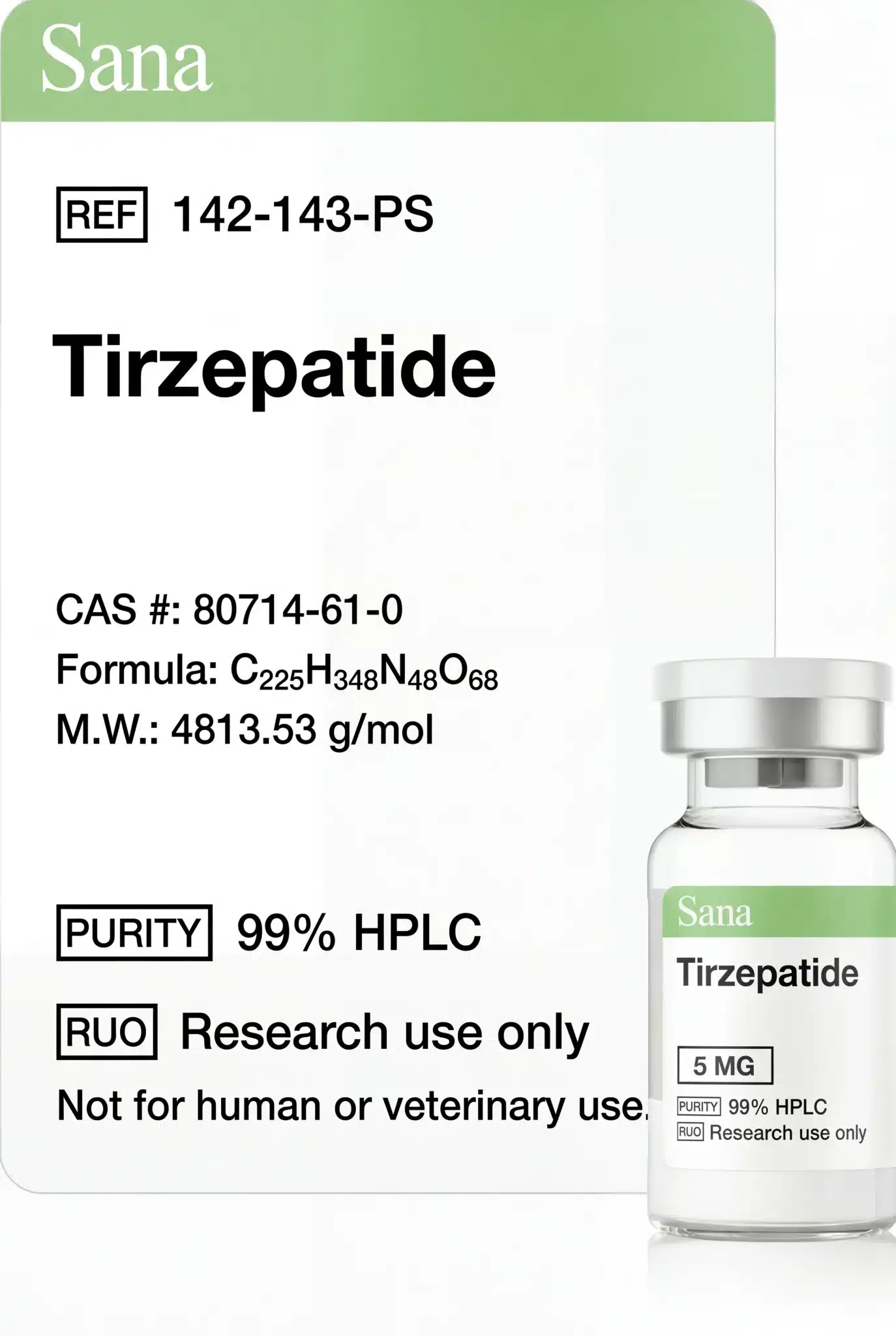
Tirzepatide: Research Overview & Mechanistic Context
Tirzepatide is a synthetic peptide analog engineered for the investigation of metabolic and endocrine signaling pathways. It functions as a dual agonist at the GIP and GLP-1 receptors, enabling researchers to study coordinated incretin receptor activity under controlled experimental conditions. Its dual-receptor profile makes Tirzepatide an important tool for examining mechanisms associated with glucose homeostasis, energy regulation, and peptide-mediated signaling.
Unlike single-pathway incretin analogs, Tirzepatide is studied as a dual-agonist system, supporting research into receptor synergy, pathway interactions, and downstream metabolic effects.
Development & Research Quality Standards
At Sana, Tirzepatide formulations are produced under stringent quality standards and subjected to analytical verification to ensure purity, identity, and batch-to-batch consistency. This compound is supplied exclusively for laboratory and educational research use and is commonly employed in metabolic signaling studies, receptor pharmacology research, and peptide-based formulation development.
Each batch is carefully handled to maintain molecular stability and integrity, supporting reproducible outcomes in advanced research environments.
Biochemical Characteristics
Compound Type: Synthetic peptide (dual agonist)
Primary Targets: GIPR, GLP-1R
Molecular Formula (free base): C₂₂₅H₃₄₈N₄₈O₆₈
Approx. Molecular Weight: 4813.53 g/mol
Peptide Class: Modified long-acting incretin analog
Administration Form (research): Lyophilized peptide
Source: PubChem / peer-reviewed scientific literature
Mechanistic & Pathway Context
Tirzepatide is studied as a dual-receptor signaling probe designed to activate GIP and GLP-1 pathways concurrently. Preclinical and mechanistic literature commonly describes its use in evaluating:
-
cAMP-mediated intracellular signaling dynamics
-
Glucose-responsive endocrine regulation pathways
-
Incretin receptor synergy and signaling bias
-
Energy balance and metabolic pathway modulation
Mechanistic research explores how coordinated receptor activation may influence insulin signaling, glucoregulatory feedback systems, and whole-body metabolic responses under experimental conditions.
Research Applications
Preclinical Studies
In vitro and animal studies frequently utilize Tirzepatide to examine:
-
Peptide–receptor binding dynamics and signaling potency
-
Downstream transcriptional responses in metabolic tissues
-
Comparative pathway activation versus mono-agonist controls
-
Biomarkers associated with metabolic regulation
Rodent and cellular models are commonly used to assess metabolic endpoints such as glucose tolerance, insulin sensitivity, receptor signaling behavior, and energy utilization markers as part of mechanistic research frameworks.
Clinical Research Context
Tirzepatide has also been evaluated in controlled human clinical research investigating its pharmacodynamic and metabolic effects. These studies are strictly investigational and provide insight into receptor interactions, dose-response characteristics, and pathway engagement without implying clinical use of research compounds.
Form & Analytical Testing
Tirzepatide is supplied as a research-grade synthetic peptide. Identity and purity are commonly verified using:
-
HPLC for purity profiling
-
Mass spectrometry for molecular mass confirmation
-
Peptide characterization techniques where applicable
Researchers should handle long-acting peptide agonists using established laboratory best practices, including temperature control, protection from light and moisture, and appropriate solvent or buffer compatibility during preparation.
Research-Only Disclaimer
⚠ For Laboratory Research Only (RUO).
Not for human use, medical use, diagnostic use, or veterinary use.
All information provided is for educational and informational purposes only and reflects findings from controlled research environments. This compound is not approved to diagnose, treat, cure, or prevent any disease. Bodily introduction into humans or animals is strictly prohibited outside approved research protocols.