
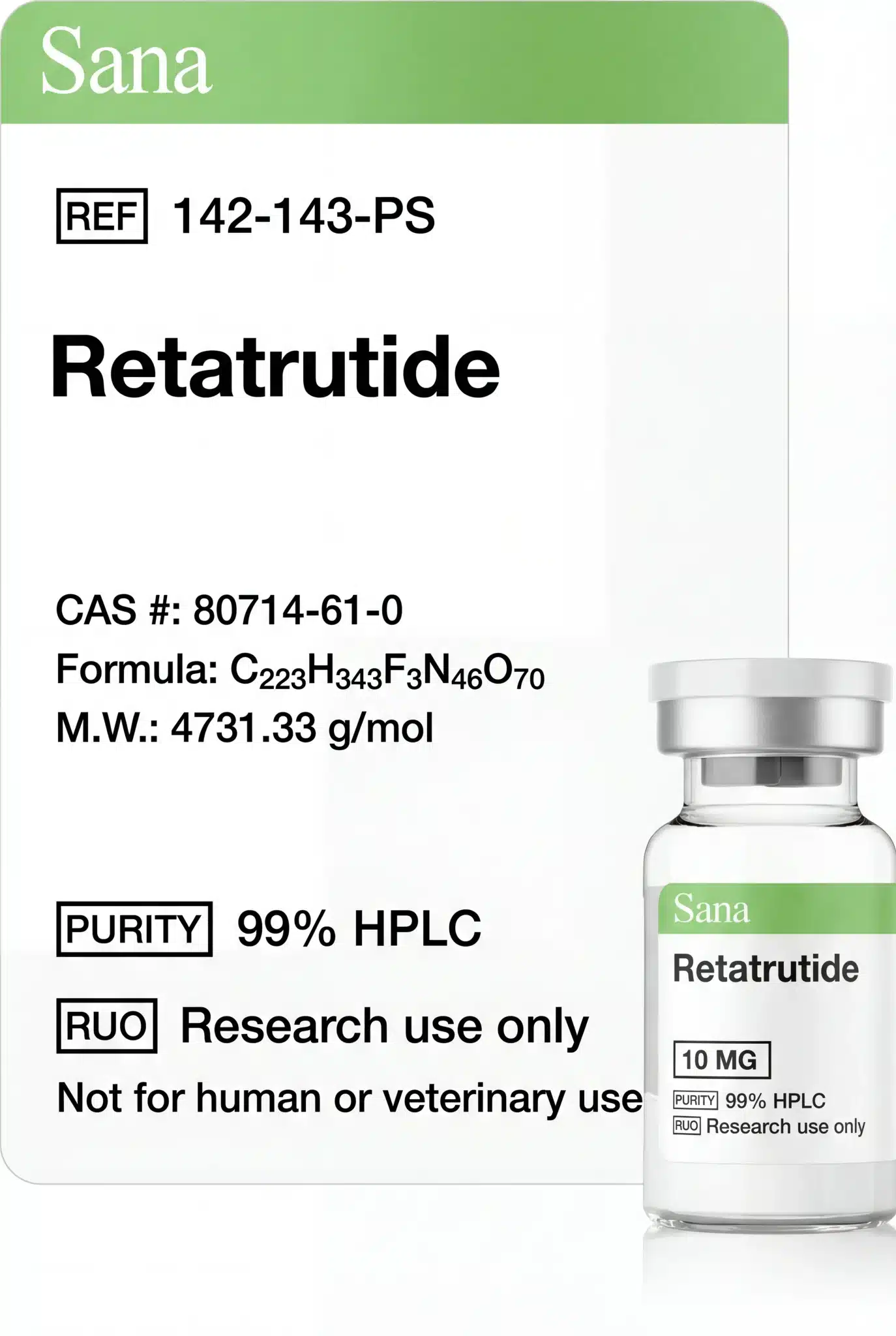

Retatrutide (10mg)
Original price was: $129.99.$99.99Current price is: $99.99.
Retatrutide is a synthetic peptide widely studied for its role in metabolic signaling pathways, energy regulation, and endocrinology-focused research. Developed under strict quality standards for research-focused applications.
In Stock
Retatrutide: Research Overview & Mechanistic Context
Retatrutide is a synthetic peptide agonist engineered to engage multiple metabolic signaling pathways through simultaneous activity at the GLP-1, GIP, and glucagon receptors. It has been extensively investigated in preclinical and clinical research settings for its role in metabolic regulation, energy expenditure signaling, and glucose-related pathway modulation.
Unlike single-pathway incretin mimetics, Retatrutide is studied as a tri-agonist system, enabling researchers to interrogate coordinated receptor signaling effects across endocrine and metabolic networks under controlled experimental conditions.
Development & Research Quality Standards
At Sana, Retatrutide formulations are developed under strict quality standards and subjected to analytical verification to ensure purity, identity, and batch-to-batch consistency. This compound is supplied exclusively for laboratory and educational research use and is commonly employed in metabolic signaling studies, receptor pharmacology research, and peptide-based formulation development.
Each batch is carefully handled to maintain molecular stability and integrity, supporting reproducible results in advanced research environments.
Biochemical Characteristics
-
Compound Type: Synthetic peptide (tri-agonist)
-
Primary Targets: GLP-1R, GIPR, GCGR
-
Molecular Formula (free base): C₂₂₃H₃₄₃F₃N₄₆O₇₀
-
Approx. Molecular Weight: 4731.33 g/mol
-
Peptide Class: Modified long-acting incretin/glucagon analog
-
Administration Form (research): Lyophilized peptide
Source: PubChem / peer-reviewed clinical literature
Mechanistic & Pathway Context
Retatrutide is studied as a multi-receptor signaling probe designed to activate incretin and glucagon pathways concurrently. Preclinical literature describes its use in evaluating:
-
cAMP-mediated intracellular signaling
-
Energy expenditure and lipid metabolism pathways
-
Glucose-responsive endocrine feedback loops
-
Receptor synergy and bias across GLP-1, GIP, and glucagon systems
Mechanistically, research emphasizes how coordinated receptor activation may reshape metabolic flux, hepatic glucose handling, adipose tissue signaling, and whole-body energy balance under experimental conditions.
Research Applications
Preclinical Studies
In vitro and animal studies utilize Retatrutide to examine:
-
Peptide–receptor binding dynamics and signaling potency
-
Downstream transcriptional responses in metabolic tissues
-
Changes in lipid oxidation and energy utilization markers
-
Comparative pathway activation versus mono-agonist controls
Rodent models are commonly used to assess metabolic endpoints such as body-weight regulation, glucose tolerance, insulin sensitivity, and hepatic lipid signaling as part of mechanistic research programs.
Clinical Research Context
Retatrutide has also been evaluated in controlled human clinical trials to study its pharmacodynamic and metabolic effects. These trials are framed strictly as investigational research and provide insight into receptor synergy, dose-response relationships, and pathway engagement rather than clinical use recommendations.
Selected Peer-Reviewed & Clinical References
-
Jastreboff et al. “Triple-Hormone-Receptor Agonist Retatrutide for Obesity.”
New England Journal of Medicine, 2023.
DOI: 10.1056/NEJMoa2301972 -
Coskun et al. “Discovery and Preclinical Characterization of a Novel Triple Agonist for the Treatment of Metabolic Disease.”
Cell Metabolism, 2022.
DOI: 10.1016/j.cmet.2022.05.012 -
Knerr et al. “Multi-agonist peptides: Emerging approaches in metabolic research.”
Nature Reviews Drug Discovery, 2023.
DOI: 10.1038/s41573-023-00683-1 -
Frias et al. “Pharmacology and Metabolic Effects of Incretin-Based Multi-Agonists.”
Diabetes Care, 2021.
DOI: 10.2337/dci21-0015
Form & Analytical Testing
Retatrutide is supplied as a research-grade synthetic peptide. Identity and purity are commonly confirmed using:
-
HPLC for purity profiling
-
Mass spectrometry for molecular weight confirmation
-
Peptide mapping and amino-acid analysis where applicable
Researchers should handle long-acting peptide agonists using standard laboratory best practices, including temperature control, protection from light and moisture, and appropriate solvent/buffer compatibility during experimental preparation.
Research-Only Disclaimer
⚠ For Laboratory Research Only (RUO).
Not for human use, medical use, diagnostic use, or veterinary use.
All information provided is for educational and informational purposes only and reflects findings from controlled preclinical and clinical research. This compound is not approved by the FDA to diagnose, treat, cure, or prevent any disease. Bodily introduction into humans or animals is strictly prohibited outside of approved research protocols.
Storage & Handling
-
Store in a cool, dry place
-
Avoid exposure to heat, moisture, and light
-
Use appropriate laboratory handling procedures
-
Ensure container remains sealed when not in use
Related products

Recently Viewed Products

In Stock